
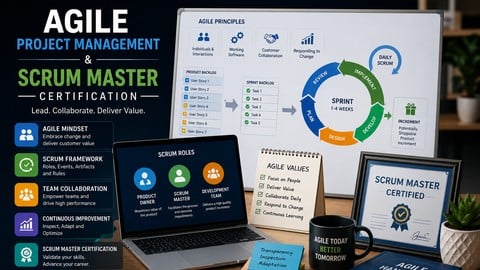
Master Agile methodologies, lead Scrum teams, and deliver successful corporate projects from start to finish.
What You Will Learn:
- Master the core principles of Agile project management and the complete Scrum framework.
- Lead and facilitate Sprint Planning, Daily Stand-ups, Sprint Reviews, and Retrospectives.
- Write effective User Stories, manage the Product Backlog, and track project velocity.
- Prepare for recognized Scrum Master certification exams to boost your corporate resume.
Learning Tracks: English
Add-On Information:
-
Course Caption: Master Agile methodologies, lead Scrum teams, and deliver successful corporate projects from start to finish.
-
Course Overview
- Deep dive into the overarching Agile philosophy, emphasizing iterative development, collaboration, and continuous feedback for optimal project outcomes.
- Comprehensive mastery of the Scrum framework, detailing its core values, principles, and empirical process control: transparency, inspection, adaptation, for complex product delivery.
- Thorough examination of the distinct accountabilities and interdependent dynamics of the Product Owner, Development Team, and Scrum Master roles within an Agile ecosystem.
- Advanced techniques for effective Product Backlog refinement, including prioritization models like MoSCoW, Weighted Shortest Job First (WSJF), and Kano, ensuring maximum value delivery.
- Understand the Scrum Master’s role as a true servant leader, fostering self-organizing teams, coaching individuals, and systematically removing impediments.
- Explore strategies for scaling Agile principles and Scrum practices within larger organizations, introducing concepts from frameworks like SAFe or LeSS for enterprise-level adoption.
- Interpret and communicate crucial Agile metrics—cycle time, lead time, and team throughput—to provide data-driven insights for continuous improvement and predictability.
- Gain practical insights into navigating common organizational challenges during Agile transformations, addressing resistance to change, and cultivating an Agile culture.
-
Requirements / Prerequisites
- Foundational understanding of general business operations or project lifecycle concepts, providing context for Agile methodologies.
- Basic familiarity with product development or organizational processes, even without direct technical experience.
- An open and collaborative mindset, ready to embrace iterative learning and adaptive problem-solving.
- Comfort actively participating in discussions and group exercises, as teamwork is central to Agile education.
- No prior formal Agile or Scrum experience is necessary; this course is designed for both beginners and those seeking certification.
-
Skills Covered / Tools Used
- Servant Leadership: Cultivate the ability to empower teams, facilitate decisions, and resolve conflicts, guiding without direct command.
- Advanced Facilitation: Master techniques for leading productive Scrum events, retrospectives, brainstorming sessions, and cross-functional team collaborations.
- Coaching & Mentoring: Develop skills to guide team members and stakeholders in adopting Agile practices and embodying Scrum values.
- Impediment Resolution: Learn systematic approaches to identify, analyze, and swiftly remove obstacles hindering team performance.
- Stakeholder Engagement: Build strategies for transparent communication, expectation management, and collaborative decision-making with all project stakeholders.
- Agile Analytics: Proficiency in utilizing data from burn-downs, burn-ups, and cumulative flow diagrams to assess project health and forecast outcomes.
- Team Dynamics & Building: Understand how to foster psychological safety, high performance, and continuous improvement within diverse team structures.
- Digital Collaboration Tools: Hands-on experience with industry-standard Agile management software such as Jira, Azure DevOps, Miro, or Asana for tracking work and fostering collaboration.
- Visual Management: Employ Kanban boards, value stream mapping, and other visual techniques to enhance workflow transparency and process efficiency.
-
Benefits / Outcomes
- Accelerated Career Advancement: Unlock roles as a certified Scrum Master, Agile Project Manager, or Agile Coach in a high-demand market, boosting your professional trajectory.
- Improved Project Performance: Significantly enhance project success rates, product quality, and stakeholder satisfaction by implementing efficient Agile and Scrum practices.
- Effective Team Empowerment: Gain the expertise to build, coach, and support highly effective, self-organizing teams capable of sustained high performance.
- Organizational Agility Contributor: Play a key role in driving organizational change, fostering a culture of adaptability, innovation, and continuous value delivery.
- Globally Recognized Credentials: Successfully prepare for and achieve esteemed Scrum Master certifications (e.g., PSM I, CSM), affirming your expertise worldwide.
- Strategic Problem-Solving: Develop a robust, iterative approach to complex problem-solving, minimizing risk and maximizing value delivery through incremental progress.
- Influential Leadership: Master a non-hierarchical leadership style focused on influence, support, and mentorship, driving positive outcomes across teams and departments.
- Professional Network Expansion: Connect with a vibrant community of Agile professionals, expanding your knowledge base and career opportunities through shared experiences.
-
PROS
- High Industry Demand: Certified Scrum Master and Agile Project Manager roles are consistently among the most sought-after positions across technology, marketing, finance, and various other sectors, offering robust career opportunities.
- Versatile Skill Set: The Agile and Scrum principles learned are universally applicable, enhancing project delivery and team dynamics in virtually any industry or functional area.
- Empowering Role: The Scrum Master acts as a servant leader, enabling teams to excel and removing obstacles, which is a highly rewarding and impactful position.
- Enhanced Project Transparency & Adaptability: Agile frameworks provide clear visibility into project progress and foster continuous adaptation to changing requirements and market conditions.
- Focus on Value Delivery: Agile methodologies inherently prioritize delivering real business value early and frequently, optimizing resource allocation and leading to higher customer satisfaction.
-
CONS
- Significant Organizational Culture Shift Required: Successful Agile adoption often necessitates a deep cultural transformation within an organization, which can face resistance and may not be successful without strong top-down commitment.

Found It Free? Share It Fast!
The post Delivery management+Agile Delivery+Project Delivery appeared first on StudyBullet.com.
