Learn to code In Python by Develop & Build Games in Python, Python Basics, Python OOP, Python Games Projects
 Learn Python in easy and simple way.
Learn coding in Python by examples.
Learn how to use Jupyter notebook and IPython for Python coding.
Learn Python programming basics.
Learn Object Oriented Programming(OOP) in Python.
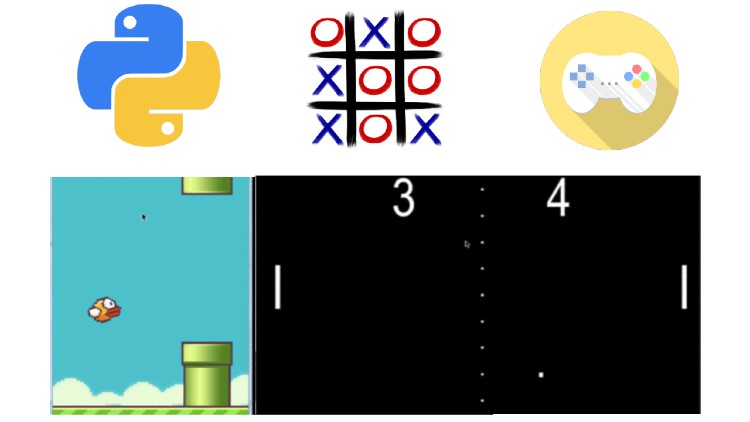
Learn How to use Pygame Python Library to build and develop Python Games
5 Python Games projects to Master The Python Powerful Skills you will learn.
Python Programming course, full Guide for Python Programmers & Python Coders in a simple and easy way with Python Examples, Python quizzes, Resources & 5 Python Games Projects in Python Games, Python OOP, to master Python 3 from zero to hero in this course.
What you will learn in this course ?
- Learn Python by doing 5 Python Games Projects.
- In this course you will learn how to Install Python 3.
- In this course you will learn how to use python IDLE.
- In this course you will learn how to choose Python IDE to learn coding.
- In this course you will learn how to Install Anaconda for Python coding.
- In this course you will learn how to use Online Jupyter for Python Programming.
- In this course you will learn how to use Python IDLE.
- In this course you will learn how What the difference between Variables & Operators in Python.
- In this course you will learn Operators Types in Python.
- In this course you will learn Python Data Types.
- In this course you will learn String Functions & entries in Python.
- In this course you will learn how to use Input String Function in Python.
- In this course you will learn Python Data Structures.
- In this course you will learn how to create Lists & lists operations in Python.
- In this course you will learn how to create Dictionaries & Dictionaries operations in Python .
- In this course you will learn how to create Tuples & Tuples operations in Python.
- In this course you will learn and when to use For Loop in Python. to create Sets & Sets operations in Python.
- In this course you will learn how and when to use Control Flow and Loops in Python.
- In this course you will learn IF Statement and control flow in Python.
- In this course you will learn how and when to use For Loop in Python.
- In this course you will learn how and when to use While Loop in Python.
- In this course you will learn how to Handle Errors in your Python programs.
- In this course you will learn how and when to use Python Functions.
- In this course you will learn how and when to create functions in Python.
- In this course you will learn how and when to use Lambda Expression in Python.
- In this course you will learn how to create and use to Python Modules.
- Lear how to use Python to open files.
- Learn coding in Python by examples in this course.
Why to master Python Programming Language by this course ?
Python is a high level programming language, strong, elegant, and easy to learn.
Python is Objective oriented programming Language so you can use objects when coding in python.
Python is Free open source programming language.
Python can be used for a large variety of programming tasks, such as for desktop applications, game programming and mobile development all of that can be done using Python programming Language.
Python is a cross platform language, which means that code written for one operating system, such as Windows, will work well on Mac OS or Linux without making any changes to the Python code.
English
Language
Introduction
Introduction
Environment Preparing for Python
Python2 VS Python3
Understanding Data Types in Python
Python Refresher
Variables, Operators and Data Types in Python.
String Functions in Python.
Data Structures in Python
Control Flow VS Loops
Error Handling in Python
Functions in Python
Files and Modules in Python
Object Oriented Programming (OOP) In Python
Creating Simple Class.
Overviewing Constructor.
Learning How to creating Dunder Methods?
Learning about Inheritance.
Knowing What is the Encapsulation?
Learning also about Multiple Inheritance
Knowing What is the Overriding?
Learning about Decorators.
Learning How to use Build-in Decorators?
Project Color Choices Game
Project Walk through
Project Helpful Notes
Project Solution
Project Hangman Game
Project Walk through
Project Helful Notes
Project Solution Part 1
Project Solution Part 2
Project Tic Tac Toc
Project Walk Through
Project Helpful Notes
Project Solution
Pygame Python Library (Module)
Pygame Library Part 1
Pygame Library Part 2
Pygame Library Part 3
Project 4
Pong Game Part 1: Create The Pong Display With The Middle Line
Pong Game Part 2: Adding The Two Paddles
Pong Game Part 3: Adding Bouncing Ball
Pong Game Part 4: Adding Score System
Pong Game Part 5: Adding Game Sound System
Project 5
Flappy Bird Game Overview
Adding Background and Base
Adding The Doubled lines of Pipes
Adding The Moving Bird
Use Collisions between The Bird & Other Game Objects
Adjust The Bird Animation
Adding The Score System
Adding The Game Sounds
Alright, let’s talk about the ‘Python Course: Learn Python By building Games in Python.’ Having navigated the labyrinth of online tech education for years, I’ve developed a pretty keen nose for what genuinely works and what’s just digital fluff. This particular course, with its game-centric approach, immediately piqued my interest. Too many Python courses drown you in dry theory or endless syntax drills. This one promises something different: a hands-on, engaging journey where you actually *build* stuff from day one. And frankly, that’s often the most effective way to learn programming.
My take? This isn’t just another beginner’s guide to Python; it’s an immersive experience designed to demystify coding through practical application. By focusing on game development with **Pygame**, the course makes complex concepts digestible and, dare I say, fun. It effectively bridges the gap between theoretical knowledge and practical implementation, making it an excellent launching pad for anyone serious about acquiring **job-ready skills** in Python. The emphasis on project-based learning means you’re not just memorizing; you’re actively problem-solving, debugging, and seeing your code come to life, which is invaluable for long-term retention and skill development.
Prerequisites
Honestly, you don’t need much beyond a curious mind and basic computer literacy. The course positions itself as suitable for beginners, and I concur. While any prior exposure to programming logic might give you a slight edge, it’s absolutely not necessary. The instructors do a commendable job of starting from the ground up, explaining fundamental concepts clearly before moving on to more intricate topics. If you can install software and navigate files, you’re pretty much good to go. No arcane knowledge of algorithms or data structures required to get started.
Skills & Tools
This course packs a solid punch in terms of the skills and tools you’ll acquire. Here’s a rundown:
- Python Programming Basics: You’ll get a firm grasp of core Python syntax, data types, variables, control flow (conditionals, loops), functions, and modules. This forms the bedrock for any future Python endeavors.
- Object-Oriented Programming (OOP) in Python: A crucial skill for writing scalable and maintainable code. The course delves into classes, objects, inheritance, and encapsulation – concepts that are fundamental for **career growth** in software development.
- Pygame Python Library: This is the star of the show. You’ll learn how to use this powerful **industry-standard tool** for 2D game development, including handling sprites, events, graphics, sound, and animations.
- Jupyter Notebook & IPython: You’ll become proficient with these interactive computing environments, which are not only excellent for learning and experimentation but also widely used in data science, machine learning, and rapid prototyping. These are truly **industry-standard tools** for modern Python development.
- Problem-Solving & Debugging: Through the 5 game projects, you’ll naturally develop crucial problem-solving skills and learn how to effectively debug your code, which is arguably one of the most important aspects of being a developer.
Career Benefits & Job Roles
While this course won’t instantly make you a senior game developer, it provides a robust foundation that can open doors to several exciting career paths. The **real-world projects** you complete serve as a fantastic portfolio for showcasing your practical coding abilities. This course directly contributes to building **job-ready skills** for:
- Entry-Level Python Developer: The foundational Python and OOP skills are universally applicable.
- Indie Game Developer: You’ll have the practical knowledge to start building your own 2D games.
- Automation Engineer: Python is a king in automation, and the scripting knowledge gained here is highly transferable.
- Data Science/Analyst (Entry-Level): While not a data science course, strong Python fundamentals are a prerequisite for this field, and using **Jupyter Notebook** is a direct step towards it.
The structured learning and practical application of concepts lay excellent groundwork for continuous **career growth** and even **certification prep** for more advanced Python specializations down the line.
Pros
- Truly Project-Based Learning: This isn’t just theory; it’s five complete game projects. You learn by doing, which is incredibly effective for cementing concepts and building confidence. These are genuine **hands-on labs**.
- Engaging and Fun Content: Learning to code can be tedious, but building games makes it highly motivational and keeps boredom at bay. It’s a fantastic way to introduce complex topics in an accessible manner.
- Comprehensive Foundation: It takes you from absolute beginner concepts to mastering **Object-Oriented Programming** in Python, ensuring a solid understanding of core principles.
- Practical Tooling: The inclusion of **Jupyter Notebook**, **IPython**, and the **Pygame** library means you’re learning with tools widely used in the industry, enhancing your **job-ready skills**.
Cons
- Specialized Scope: While excellent for game development, the course doesn’t delve into other major Python domains like web development (e.g., Django, Flask), data analysis libraries (Pandas, NumPy), or machine learning. If your primary goal is a broad, full-stack Python overview beyond games, you’ll need supplementary courses. It’s focused, which is a strength for its niche, but a limitation if you’re looking for an all-encompassing “Python for everything” curriculum.

Found It Free? Share It Fast!
The post Python Course:Learn Python By building Games in Python. appeared first on StudyBullet.com.
