
Understanding how global warming and climate change are affecting our lives.
What you will learn
Learn the causes of climate change
Understand the link between global warming and climate change
Learn the consequences of climate change
Establish the importance and urgency to take action to stop climate change
Description
Hi everyone,
In this course, we will address the climate change phenomenon from many angles and we will discuss its causes, consequences, and solutions.
Greenhouse gases are the reason behind this phenomenon. These gases, mainly carbon dioxide, methane, and nitrous oxide, have increased in concentration in recent years in the atmosphere because of fossil fuel combustion, agriculture and livestock, and deforestation.
These gases hold solar radiation and increase the earth’s temperature, which leads to global warming which eventually causes climate change. The increase of carbon dioxide concentration in the air causes also oceans acidification.
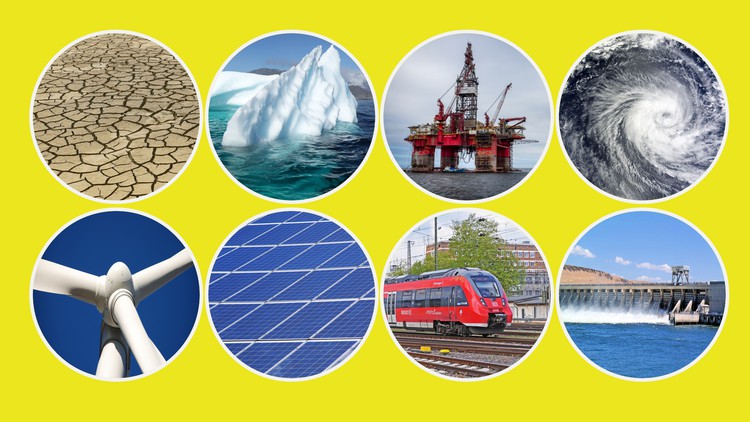
Climate change generates a lot of unwanted effects on many levels such as Extreme weather event intensification like floods and droughts, melting of ice caps and glaciers, propagation of diseases and pests, habitat destruction, coral bleaching, and many social and economic impacts.
Thus, we organized the course on climate change into three parts :
• Part one discusses direct causes of climate change, mainly fossil energy, agriculture, and deforestation, and indirect causes like capitalism, corporate lobbying, cryptocurrency, and science deniers. It also explains greenhouse gases’ origins and the concepts of global warming and climate change.
• Part 2 details some of climate change consequences, such as :
• Extreme weather and natural disasters
• Ice Melting
• Disease carrier and pest propagation
• Habitat destruction and wildlife loss
• Coral reef destruction
• Economic and social consequences
• Part 3 is dedicated to solutions to stop climate change, which includes solutions on governmental and individual levels, renewable energy, and transport electrification.
I hope you enjoy the course!
Content
Introduction
Climate change explained
Climate change consequences
How to stop climate change
Conclusion
Overview
Alright, let’s cut to the chase. In an age where every other headline screams about melting glaciers or unprecedented heatwaves, a course like ‘Climate Change Explained: Causes, Consequences and Solutions’ isn’t just timely, it’s damn near essential. For anyone feeling that persistent hum of anxiety about the planet’s future, or perhaps just bewildered by the sheer volume of conflicting information out there, this course acts as a much-needed grounding force. My take? It brilliantly strips away the jargon and hyperbole, delivering a crystal-clear narrative that connects the scientific dots, societal impacts, and, crucially, the pathways forward. It’s not just about understanding the ‘what’ – it’s about grasping the ‘why’ and, most importantly, the ‘how to respond.’ It’s comprehensive without being overwhelming, offering a holistic perspective that moves beyond mere scientific explanation to touch on policy, economics, and individual responsibility. Frankly, it’s the kind of foundational knowledge that every informed citizen, especially those of us navigating the complexities of the tech world, should possess. This course manages to make a colossal, intimidating topic accessible and actionable.
Prerequisites
Here’s the deal: if you can read, think critically, and possess a healthy dose of curiosity about the world around you, you’re pretty much good to go. This course is remarkably beginner-friendly, requiring no prior scientific background or specialized knowledge. Forget needing a degree in environmental science or advanced calculus; the instructors do an excellent job of simplifying complex topics without dumbing them down. It’s designed for a broad audience, from high school students to seasoned professionals, making it accessible for anyone looking to upskill their understanding of one of humanity’s biggest challenges. So, if you’ve been putting off learning about climate change because it felt too daunting, consider this your entry point. It truly starts from the ground up, making complex ideas understandable for everyone.
Skills & Tools
While you won’t be writing Python scripts for climate models or deploying IoT sensors for environmental monitoring, the “skills” you’ll hone here are far more fundamental and equally invaluable. You’ll develop enhanced critical thinking skills to evaluate climate-related information, learn to effectively communicate complex scientific concepts to non-experts, and gain a profound understanding of systems thinking as it applies to global ecological and economic challenges. The course provides mental frameworks and analytical tools to interpret data and reports, like those from the IPCC, helping you understand how experts utilize industry-standard tools for climate modeling and data analysis. You’ll learn to dissect cause-and-effect relationships across various domains – from atmospheric science to geopolitics – which is a potent skill transferable to virtually any sector. Furthermore, you’ll acquire a vocabulary and conceptual toolkit that enables you to engage meaningfully in discussions about sustainability, renewable energy, and corporate responsibility, making you a more informed and influential voice in any professional setting. This isn’t about specific software, it’s about mastering the intellectual toolkit needed to navigate this complex subject.
Career Benefits & Job Roles
Think climate change isn’t relevant to your tech career? Think again. Understanding the nuances of climate change is rapidly becoming a job-ready skill across an expanding array of sectors. For tech professionals, this knowledge can be a significant catalyst for career growth. Consider roles in ESG (Environmental, Social, and Governance) consulting, where you might help companies align their operations with sustainability goals. Data scientists and analysts can find themselves working on projects involving climate modeling, carbon footprint analysis, or renewable energy optimization. Software developers might contribute to green tech solutions or platforms facilitating carbon trading. Project managers with this foundational understanding are invaluable in renewable energy infrastructure development or sustainable supply chain initiatives. While not a direct certification prep course for specific tech stacks, the foundational understanding it provides is invaluable for anyone pursuing sustainability or ESG-related certifications, or even for contributing to real-world projects focused on climate resilience and adaptation. The business world is increasingly recognizing the financial risks and opportunities associated with climate change, making informed professionals indispensable across roles ranging from strategic planning to innovation and risk management.
Pros
- Exceptional Clarity & Accessibility: The course masterfully breaks down incredibly complex scientific principles and societal challenges into easily digestible modules. No prior science degree needed, just a willingness to learn. It excels at making the daunting feel manageable, a true beginner to advanced journey in understanding.
- Holistic & Interconnected View: Unlike many resources that focus solely on science or policy, this course skillfully weaves together causes, consequences, and a broad spectrum of solutions. It helps you connect the dots between atmospheric physics, economic impacts, social justice, and technological innovations, providing a truly comprehensive picture.
- Action-Oriented & Empowering: This isn’t just a doom-and-gloom narrative. While it doesn’t shy away from the severity of the crisis, it dedicates significant time to exploring viable solutions, both global and individual. It instills a sense of urgency alongside practical knowledge, empowering learners to think about how they can contribute to positive change and drive career growth in sustainable fields.
- Relevance Across Disciplines: The insights gained are universally applicable. Whether you’re in tech, finance, policy, or any other field, understanding climate change impacts decision-making, innovation, and strategic planning. It’s foundational knowledge for the 21st century, enhancing critical thinking skills relevant to any real-world projects.
Cons
- Limited Direct Hands-on Application: From a tech professional’s perspective, accustomed to hands-on labs or coding challenges, this course is primarily conceptual. While it covers solution frameworks and policy approaches, it doesn’t provide opportunities to directly work with climate data, build models, or develop specific climate tech solutions. It’s more about understanding the problem space and the broad strokes of solutions, rather than diving deep into the technical implementation or specific industry-standard tools used by climate scientists or engineers. If you’re looking for a course to directly upskill your coding for climate tech, this isn’t it; however, it provides the essential context.

Found It Free? Share It Fast!
The post Climate Change Explained: Causes, Consequences and Solutions appeared first on StudyBullet.com.
