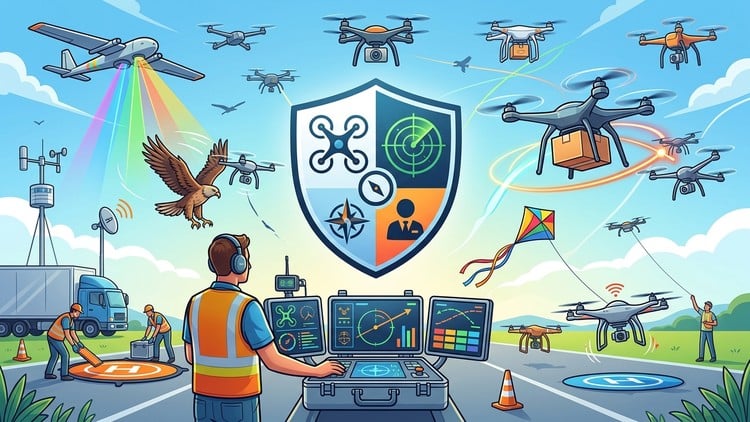
Learn leadership, safety systems, and fleet management for professional drone teams.
What You Will Learn:
- Lead drone teams effectively and ensure full compliance with FAA regulations and company policies.
- Plan advanced missions, including complex logistics and waiver applications for BVLOS flights.
- Implement Safety Management Systems (SMS) to audit risks and prevent accidents before they happen.
- Manage drone fleet maintenance, handle emergencies, and lead incident command during a crisis.
Beyond the Joystick: A Deep Dive into Supervisor-Level Command
If you’ve been in the commercial drone space for more than a minute, you know the “honeymoon phase” of just being a pilot is starting to fade. The industry is maturing fast. We’re moving away from the “one pilot, one drone” model toward massive, enterprise-level UAS drone programs. I recently spent some serious time digging through the ‘UAS Drone Operations Supervisor 500+ Practice Questions 2026’ course, and honestly, it’s about time someone focused on the “manager” side of the radio controller. This isn’t your standard Part 107 certification prep; it’s a blueprint for the people who actually run the show when the stakes are high.
What struck me most about this curriculum is that it doesn’t waste time teaching you how to fly. It assumes you already know how to not crash. Instead, it forces you to think like a Chief Pilot or an Operations Manager. We’re talking about the high-level career growth that moves you out of the high-vis vest and into the strategy room. In 2026, the regulatory landscape is a minefield, and this course treats FAA regulations not just as rules to follow, but as a framework to build a business around. It’s dense, it’s challenging, and it’s exactly what the industry needs right now.
Prerequisites
Look, if you’re a complete beginner to advanced dreamer, don’t start here. This course isn’t for the hobbyist who just unboxed their first Mavic. To get the most out of these 500+ practice questions, you really need:
- An active FAA Part 107 Remote Pilot Certificate (or equivalent international license).
- At least 50+ hours of documented commercial flight time to understand the real-world projects context.
- A basic understanding of cloud-based software, as you’ll be looking at industry-standard tools for data logging.
- A “leadership first” mindset—this is about managing people and assets, not just flight lines.
Skills & Tools
The course goes heavy on the “Supervisor” toolkit. You aren’t just learning theory; you’re learning how to implement job-ready skills that actually keep a company from getting sued or grounded. You’ll dive deep into Safety Management Systems (SMS), which is becoming the gold standard for any serious drone outfit.
You’ll also get exposure to the logic behind BVLOS (Beyond Visual Line of Sight) waiver applications. In the simulated questions, you’ll be tasked with evaluating fleet maintenance logs and identifying red flags in pilot performance data. It’s very much about the “paperwork” that keeps the rotors turning. You’ll learn how to navigate incident command structures, which is vital if you ever want to work in public safety or large-scale industrial inspection where drones are just one part of a much larger emergency response.
Career Benefits & Job Roles
This is where the ROI of this course really shines. We’re seeing a massive shift where companies like Amazon, UPS, and major construction firms are looking for “Drone Program Leads” rather than just contract pilots. Completing this level of training prepares you for roles like UAS Operations Manager, Chief Drone Pilot, or Director of Unmanned Systems.
The career growth potential here is significant because it bridges the gap between technical flight skills and corporate management. You become the person who can talk to both the FAA and the Board of Directors. By mastering the hands-on labs (simulated through complex scenarios in the questions), you’re positioning yourself for six-figure roles that require a deep understanding of risk mitigation and operational scalability.
Pros
- Unmatched Depth: The questions don’t just ask “what is the rule?” They ask “how do you apply this rule during a mid-air emergency?” It’s the most realistic certification prep I’ve seen for supervisors.
- Future-Proofed: Since it’s geared toward 2026 standards, it covers Remote ID, BVLOS, and Night Ops without the outdated fluff found in older courses.
- Focus on SMS: The emphasis on Safety Management Systems is a game changer. It teaches you how to audit your own team before the FAA does it for you.
- Complex Logistics: It handles the “boring” but essential stuff—like battery cycle management and firmware versioning across a 20-drone fleet—better than any other resource.
Cons
- Heavy Reading Load: Let’s be honest, the regulatory and compliance sections are dry as a bone. If you don’t have a high tolerance for legalistic language and complex FAA policy documents, you’re going to find some of the 500+ questions a bit of a slog. It’s definitely more “desk work” than “field work.”

Found It Free? Share It Fast!
The post UAS Drone Operations Supervisor 500+ Practice Questions 2026 appeared first on StudyBullet.com.
